Once in a while my professional life and my current interests intersect. I’m preparing a trip to Spain and I was invited to give a lecture based on my parents Civil War letters to some Gender Studies students at the University. Yes, I know, I’m supposed to be retired, but they didn’t get the memo. It beats talking about our current politics; I’ll have to do that with the inquisitive taxi drivers, who can tell that I am an American as soon as I step out of the airport.
I decided to focus on the Greek myth of Pygmalion for the lecture. After looking for a long time for a suitable wife, Pygmalion created a beautiful ivory sculpture of a woman he named Galatea with whom he fell in love. Thanks to the goddess Aphrodite’s intervention, the statute became human just as Pygmalion desired and they married. Ovid, among many others, tells us this myth in his Metamorphoses.
I plan to tell the students that my father tried to shape my mother bit by bit in his letters to her before they were married. First, he asked her to change her school-girl handwriting to a more artistic one he liked better. He advised her which books to read and which ones to avoid. He was particularly smitten by the novel Doctor Arrowsmith by Sinclair Lewis, which had been translated into Spanish. Martin Arrowsmith wanted to marry Leora as soon as possible, without waiting to finish his studies. When my father proposed the same idea to my mother, she answered with a chilly “I guess so, whatever you like.” My dad had the custom to repeat his questions until he got the answer he wanted. By the time he asked her again, she had read the book and realized that Martin and Leora had eloped. That time my mother’s letter was hot and to the point: “If you think I’m going to be a detriment for you to finish your career, from now on, I’ll be like a second sister to you.” 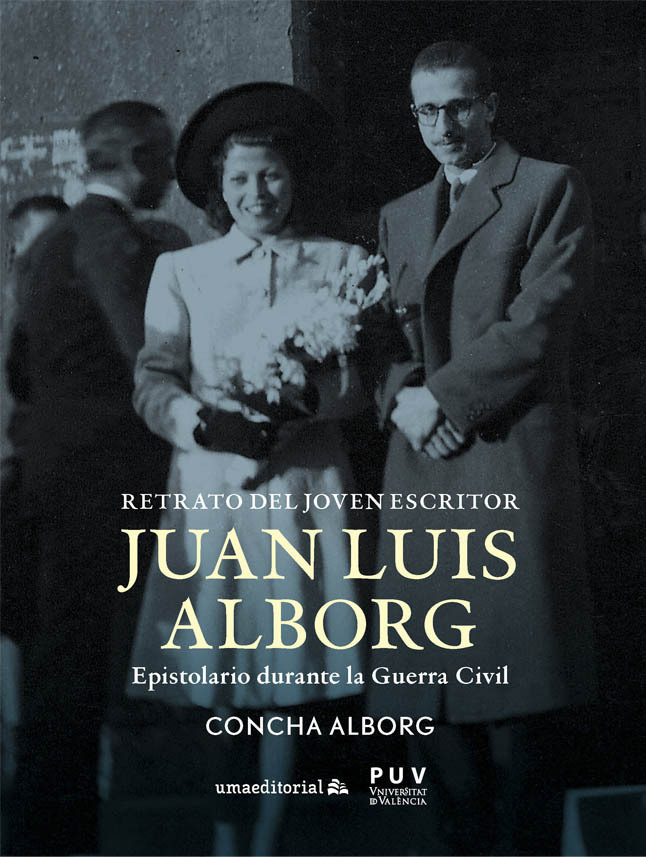 All you need to do is to look at the cover of my book to see that my mother won that battle. She looks radiant on her wedding day and my father appears resigned. No elopement for this Galatea, so much for the Greek myth.
Of course, I couldn’t leave the Pygmalion myth alone and read Bernard Shaw’s five-act play. Henry Higgins, a professor of phonetics, teaches Eliza Doolittle to speak proper English. He says: “A woman who utters such depressing and disgusting sounds has no right to be anywhere—no right to live.” This play is more about social class than romantic love, until the last act when she decides to marry someone else. Because the audiences wanted a happy ending, there are different versions of this Pygmalion. The one I read in Kindle has a postscript by the author explaining why Eliza marries Freddy, although he is not as sophisticated as professor Higgins and it ends with these words: “Galatea never does quite like Pygmalion: his relation to her is too godlike to be altogether agreeable.”
Needless to say, I had to watch My Fair Lady, the film directed by George Cukor entirely based on Bernard Shaw’s play, with Rex Harrison as Henry Higgins and Audrey Hepburn as Eliza Doolittle. As delightful and iconic as their performances are, this film has not aged well. First of all, it isn’t true that “the rain in Spain falls mainly in the plain;” it rains in the northern provinces. And you tell me: “why couldn’t a man be more like a woman?” By the time Higgins gets used to Eliza’s face, you know this is not going to end up well. His last words said sotto voce are: “Where the devil are my sleepers?” assuming that she will fetch them.
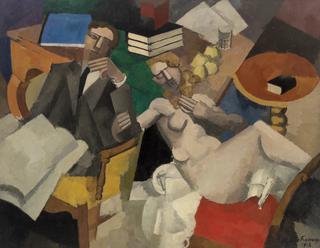 Now I see Pygmalion themes everywhere. Take one of my favorite French artists I discovered at The Barnes Foundation, cubist George de La Fresnaye. There is one of his not well-known paintings in a small gallery on the second floor, “La vie conjugale” (Married Life). The husband, dressed in suit and tie, has been reading a pile of books. His blonde, voluptuous wife is waiting patiently, holding on to his arm, completely in the buff. She looks, as Ovid said: “making herself soft and docile with his touch.”
I digress, I know. I do all kinds of crazy things before my trips to Spain. Often, I get in Spanish time, it’s easier when I arrive there, but it makes for some wacky last days at home. Stay tuned, I’ll tell you more when I return in July!